
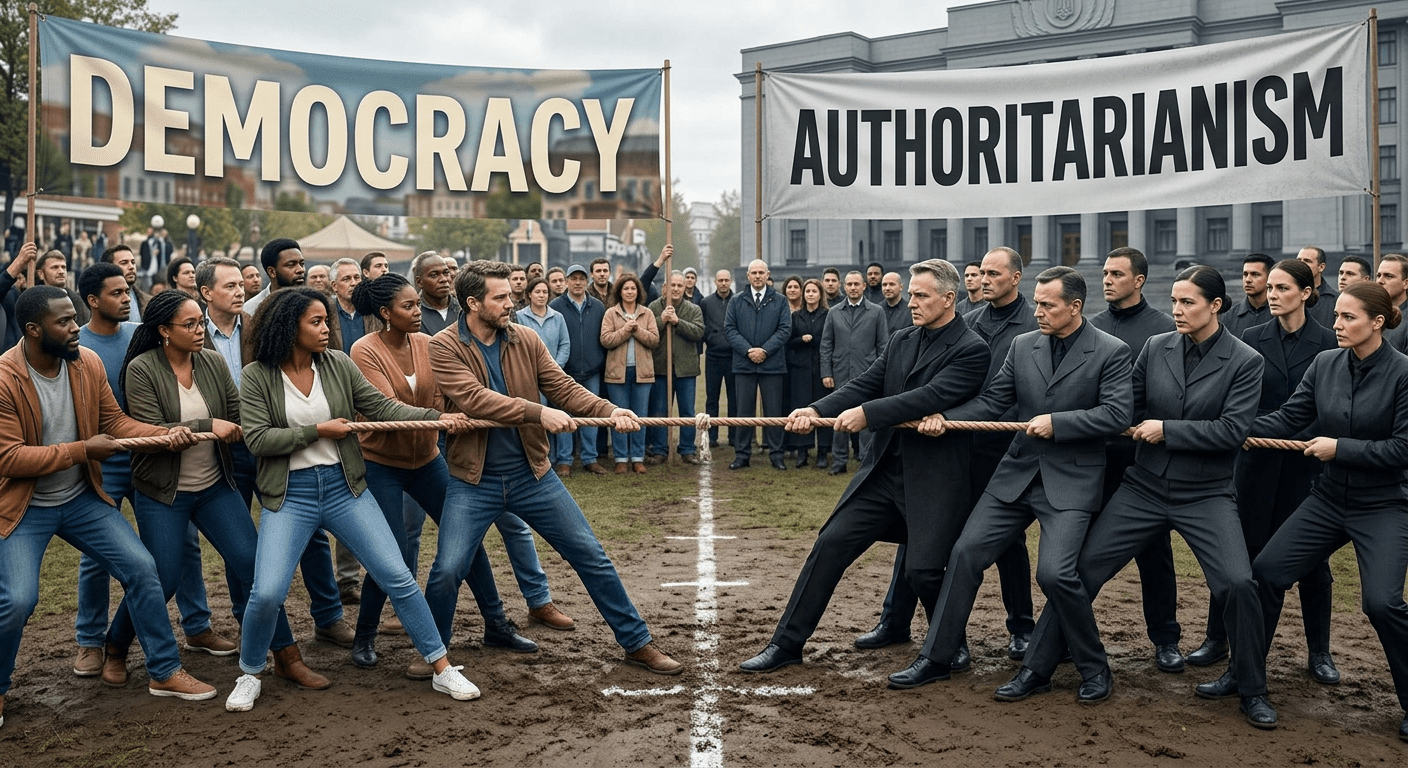
So what exactly is authoritarianism?
In simple terms, authoritarianism is a system of government where power becomes concentrated in the hands of one leader or a small group of elites. It is often marked by attacks on political dissent, weakening checks and balances, limiting civil liberties, controlling public narratives, and creating an environment where fear and division become political tools.
Sound familiar?
It should.
Because whether people want to admit it or not, many of the warning signs are not hypothetical anymore. They are happening in real time.
And yet somehow, a year and a half ago, millions of people decided it was a brilliant idea—in the name of “saving democracy”—to re-elect a man whose political strategy has consistently centered around fear, division, retaliation, and scapegoating marginalized communities.
A campaign built on “us versus them.”
A campaign that openly targeted immigrants, communities of color, LGBTQ people, educators, activists, journalists, and anyone bold enough to challenge the narrative.
A movement that praises loyalty over accountability and treats disagreement like betrayal.
And while people argue online about party loyalty and political branding, civil rights protections continue to be chipped away at piece by piece, often under the convenient disguise of “protecting freedom.”
Freedom for who exactly?
Because it certainly doesn’t feel like freedom when voting rights are weakened.
When books are banned.
When diversity initiatives are dismantled.
When protest becomes criminalized.
When educators are censored.
When entire communities are treated as political enemies simply for existing.
At some point we have to stop pretending we do not see what is happening.
To Gerrymander or Not to Gerrymander
Now let’s talk about one of America’s favorite little political magic tricks: gerrymandering.
What does it mean?
Gerrymandering is the manipulation of electoral district boundaries in order to benefit a particular political party, group, or class. In other words, politicians choosing their voters instead of voters choosing their politicians.
Democracy, but make it suspicious.
And honestly, the fact that this has become one of the major political conversations in this country should alarm all of us.
Because while everyday people are trying to survive rising costs of living, unaffordable housing, increasing homelessness, underfunded schools, healthcare struggles, and economic instability, lawmakers are spending enormous amounts of time figuring out how to redraw maps to maintain power.
Not how to improve people’s quality of life.
Not how to strengthen communities.
Not how to better support families.
No.
Maps.
Lines.
Districts.
Political chess moves designed to preserve influence and silence opposition.
And let’s be honest about something else too: much of this is deeply tied to race.
The attacks on voting access in Black and Brown communities are not accidental.
The closing of polling places is not accidental.
The constant attempts to dilute voting power are not accidental.
History has already shown us what happens when people in power fear demographic change.
And for many of us, watching these efforts unfold feels less like progress and more like a desperate attempt to drag this country backward toward a version of America that was only “great” for a very select group of people.
Honestly, at this point I keep thinking about that scene in the movie School Daze where Laurence Fishburne is running through campus ringing the bell yelling, “Wake up!”
Because that is exactly what I want to do with some of these lawmakers and people in Congress. I want to put them all in a room, ring a giant bell, and yell:
“Wake the hell up! Do something!”
Because while they are busy playing political chess games, real people are struggling. Families are struggling. Communities are struggling. And the consequences of their inaction—or intentional actions—are impacting everyday people in very real ways.
We Really Need to Do Better
What worries me most is not just the politics.
It is what all of this teaches our children.
I work with families. I work in community. I see young people trying to make sense of a world where cruelty is rewarded, dishonesty is normalized, and empathy is treated like weakness.
What are we showing them?
What lessons are they learning when leaders model bullying instead of integrity?
When misinformation spreads faster than truth?
When hate becomes campaign strategy?
When people lose the ability to disagree without dehumanizing one another?
We have to do better.
Not just politically.
Morally.
Collectively.
Humanly.
Because democracy is not just voting every few years and posting opinions online. Democracy requires participation, accountability, truth, empathy, critical thinking, and the willingness to protect the rights and dignity of people we may never even meet.
And if we lose those things?
Then what we are left with may still call itself democracy.
But it will look a lot more like authoritarianism wearing a flag pin and smiling for the cameras.


Thank you for your post. I don’t think people see the scale of the problem as clearly as you do. A few people who can’t be bothered to vote, or who are indifferent, or who think their short-term greed will pay off bigtime, can cause vast expense and difficulty for all of us in the U.S.
A painful, cascaded crash of cryptocurrency and the stock markets may save us. Or not.
LikeLike