
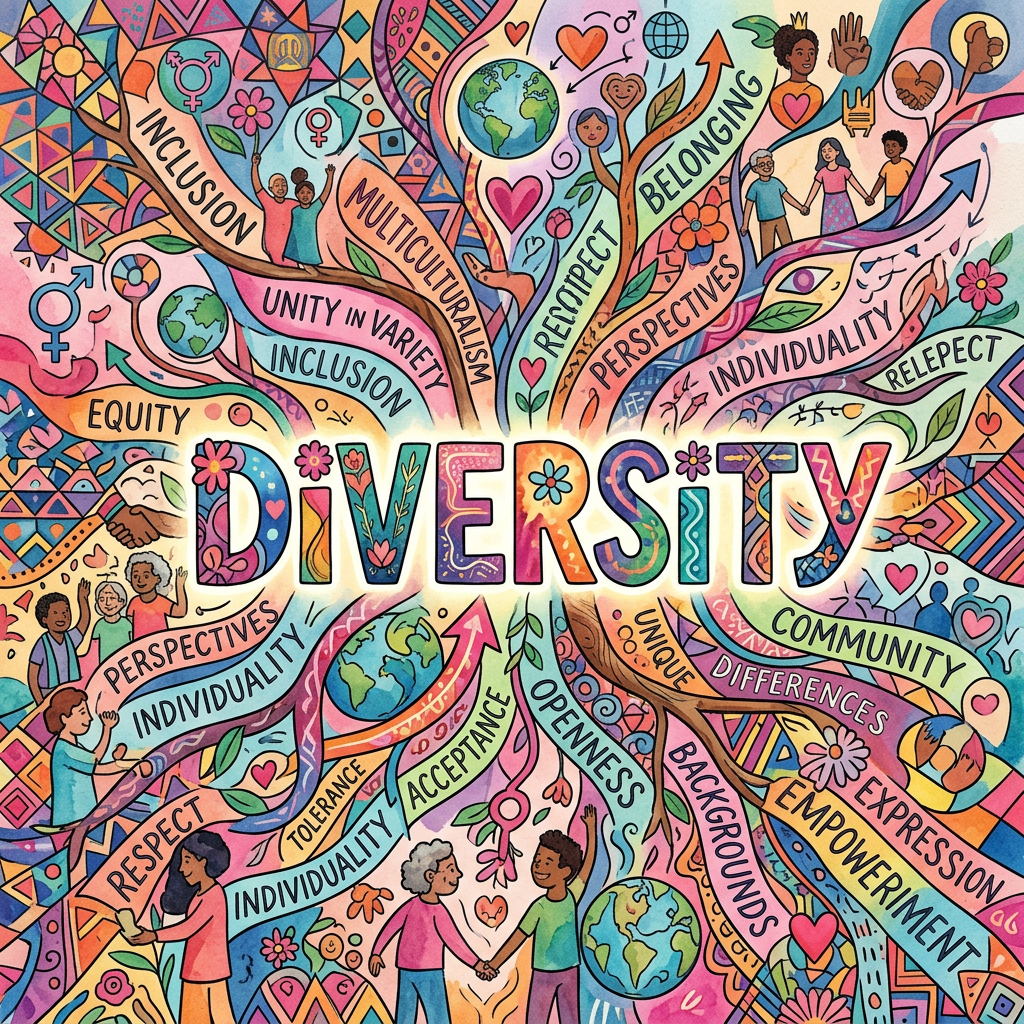
I’ve been thinking about the word diversity and how often we use it without really stopping to think about what it means.
Depending on who you ask, you’re probably going to get a different answer. And that makes sense. How we understand diversity is shaped by who we are, where we come from, how we were raised, the communities we belong to, and the experiences we’ve had along the way.
Race. Culture. Gender. Sexual orientation. Age. Religion. Education. Socioeconomic status. Disability. Politics. Geography. Family structure. Life experience. All of these things (and plenty more) shape the lens through which we see the world.
For me, diversity has always meant more than simply having folks of different races, genders, sexual identities or cultures occupying the same space. Because, quite frankly, you can put a whole bunch of different folks in a room and still not have an environment where everyone feels respected, valued, or heard.
Representation matters. But representation alone isn’t enough.
Diversity requires us to make room for different perspectives, experiences, identities, ideas, values, dreams, and ways of moving through the world. It asks us to recognize that our own experiences are not universal and that there is something to be gained when we are willing to listen to folks whose lives may look very different from our own.
And that part is important. Because somewhere along the way, diversity became a word that makes some folks uncomfortable.
For some folks, a neighborhood becoming “more diverse,” a workplace prioritizing diversity, or a school intentionally creating culturally responsive environments is somehow viewed as threatening. As though somebody else being welcomed, represented, or given an opportunity automatically means something is being taken away from them.
And well… damn…there’s a whole other blog post hiding in that conversation. 😏
But I think we also have to be careful about how we talk about diversity. It can’t simply become another buzzword we throw around because it sounds good in a strategic plan, on a website, or during a staff meeting.
And it definitely can’t become another way of separating people into an “us versus them” mentality.
The goal shouldn’t be to pretend our differences don’t exist. They absolutely do. The goal is to recognize those differences without using them to determine whose voice matters more, who belongs, who deserves opportunity, or whose humanity we are willing to recognize.
There’s tremendous value in being around folks who are different from us. It challenges assumptions. It pushes us to think beyond our own experiences. It can increase creativity, strengthen problem-solving, deepen empathy, and when we’re willing to actually listen, it can help us grow.
That’s especially important when we talk about children.
As parents, educators, and community members, we should be asking ourselves whether the environments our children grow up in truly reflect and respect the many cultures, identities, families, and experiences that make up their communities.
Children notice differences much earlier than adults sometimes want to acknowledge. They notice skin color. They notice language. They notice gender. They notice family structures. They notice disability. And they are paying attention to how the adults around them respond to those differences.
So when we avoid conversations about race, culture, gender identity, sexual orientation, and difference because we think children are “too young,” we aren’t necessarily protecting them from bias. We may simply be leaving them to make sense of what they see without giving them the language or guidance they need.
That’s why culturally responsive and inclusive education matters from the earliest years.
Children deserve opportunities to see themselves reflected in their classrooms, books, toys, curriculum, teachers, and communities. And they also deserve opportunities to learn about folks whose lives and experiences are different from their own. Both matter.
We should be creating spaces where children can share their stories while learning to listen to the stories of others. Where curiosity is encouraged. Where differences aren’t treated as something awkward that we whisper about, but as a normal and beautiful part of being human.
Because those early experiences help shape how children understand belonging, fairness, empathy, and community.
And truthfully, adults could stand to practice some of that too.
Some of the most meaningful conversations I’ve had throughout my life have been with folks whose backgrounds and experiences were very different from mine. Those conversations have challenged me, taught me, made me rethink assumptions, and sometimes reminded me that I still have some learning, (and unlearning) to do.
They’ve also given me opportunities to share my own experiences and challenge assumptions others may have carried.
As a Black lesbian woman now moving through my 50s- and listen, these 50-something eyes see some things a LOT differently than my 20-something eyes did 😂-I understand more than ever how deeply identity and lived experience shape the way we see the world.
I bring my Blackness into a room. I bring my queerness. I bring my womanhood.
I bring motherhood, leadership, community, age, experience, mistakes, lessons, joy, frustration, and everything else life has handed me along the way.
None of those things exist separately from the others. They intersect, and together they shape my perspective. The same is true for everybody else.
That’s why diversity, at its best, isn’t about checking boxes. It’s about creating communities where we don’t have to erase pieces of ourselves in order to belong.
It’s about being curious enough to listen. Secure enough to be challenged… Humble enough to admit when we don’t know something.
And open enough to understand that someone else’s experience doesn’t have to mirror ours in order for it to be real, valuable, and worthy of respect.
We don’t build stronger communities by surrounding ourselves only with people who think like us, look like us, live like us, worship like us, love like us, or vote like us.
We build stronger communities when we learn how to live with difference without turning difference into division.
And maybe that’s the conversation about diversity we need to be having now.

